What Is Market Capitalization? Market Cap Explained Simply
Market cap is a company's share price times its shares outstanding. Learn how to calculate it, what small, mid and large cap mean, and why it matters for index funds.
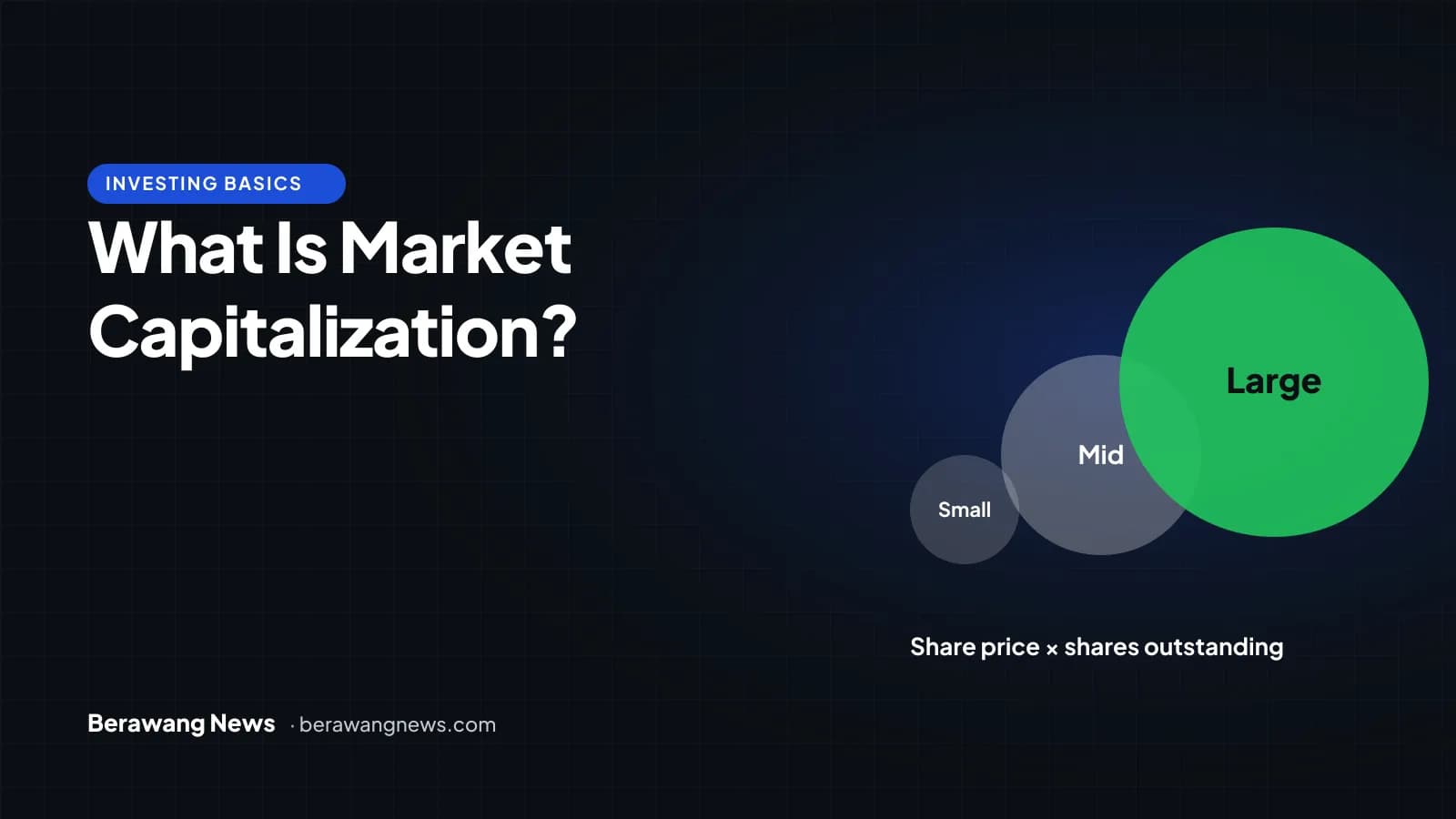
Market capitalization, or market cap, is the total value the stock market places on a company. You find it by multiplying the price of one share by the total number of shares outstanding. It is the quickest way to tell how big a public company is.
How to calculate market cap
Market cap = share price × shares outstanding
Example: a company has 250 million shares outstanding and its stock trades at $40. Its market cap is 250 million × $40 = $10 billion.
Because the share price changes all day, market cap changes with it. Most stock quotes show it next to the price; see how to read a stock quote.
Small cap, mid cap and large cap
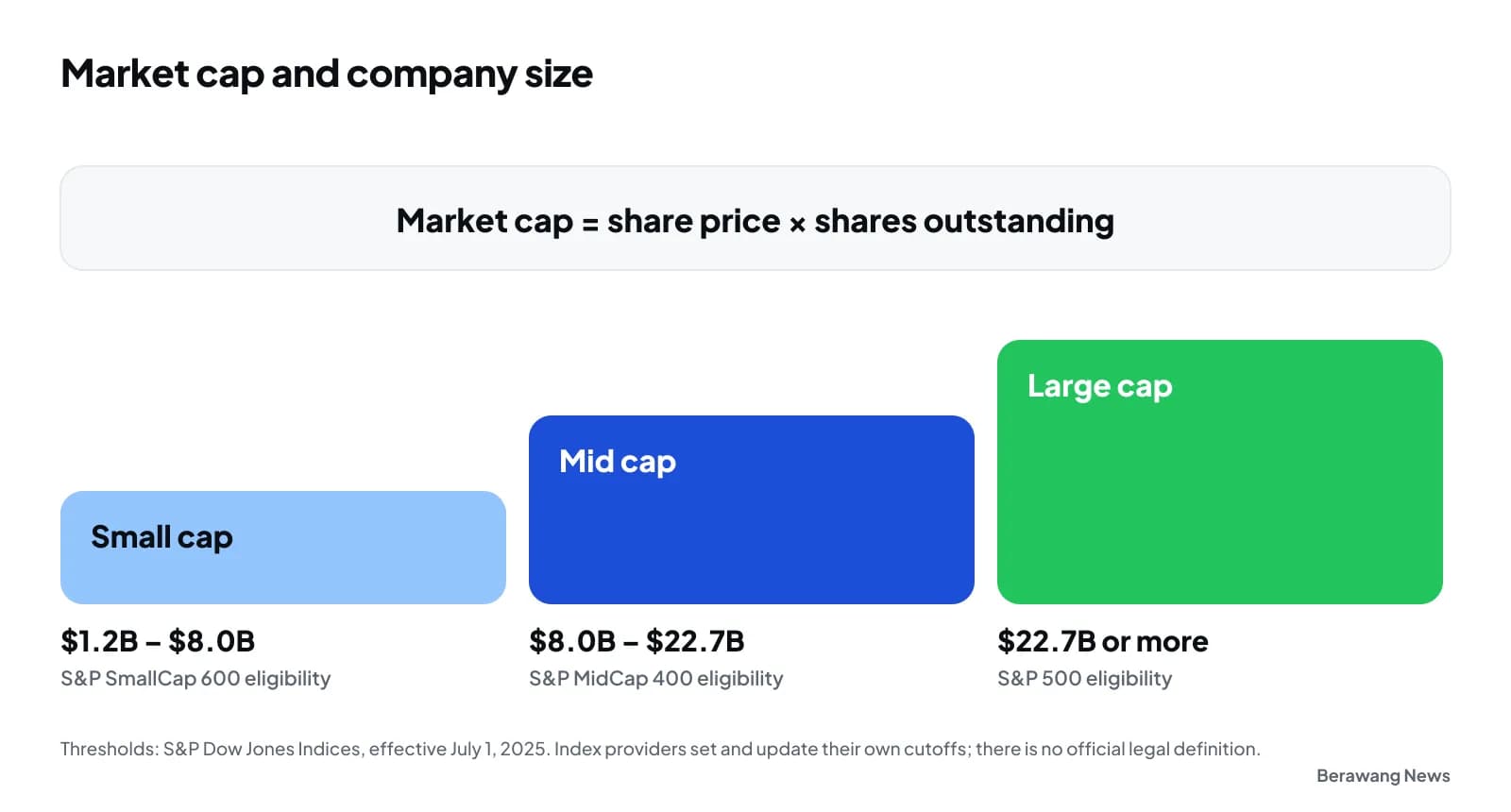
Investors group companies by size, but there is no official legal definition of each group. Investor.gov describes the terms only as a way to talk about a company’s size and market value. Index providers set their own cutoffs. For example, S&P Dow Jones Indices uses these minimums for new companies joining its U.S. indices (effective July 1, 2025):
Size | S&P index | Market cap range |
|---|---|---|
Large cap | S&P 500 | $22.7 billion or more |
Mid cap | S&P MidCap 400 | $8.0 billion to $22.7 billion |
Small cap | S&P SmallCap 600 | $1.2 billion to $8.0 billion |
S&P reviews these ranges regularly and adjusts them as markets move, and other index providers and fund companies use different cutoffs.
Why market cap matters
- Size and risk: larger companies are often more established, while smaller companies may grow faster but can be more volatile.
- Index weighting: the S&P 500 is weighted by float-adjusted market cap, so the biggest companies have the biggest effect on the index. An index fund or ETF that tracks it holds more of those companies.
- Diversification: mixing large, mid and small companies spreads your risk. See how to start investing in stocks.
Float-adjusted market cap
Not every share is available to ordinary investors. Some are held by insiders, governments, other companies or large long-term holders. Index providers like S&P count only the shares available to investors, called the float, when they weight an index. That is why a company’s float-adjusted market cap can be smaller than its total market cap.
What market cap doesn’t tell you
- Whether a stock is cheap or expensive. A large market cap doesn’t mean a good investment. Compare valuation measures such as the P/E ratio and look at the company’s earnings report.
- Debt. Market cap counts only the value of the shares, not what the company owes.
- The share price alone. A $500 stock isn’t necessarily a bigger company than a $50 stock; the number of shares matters too.
Frequently asked questions
Is a higher market cap better?
Not necessarily. It means the company is bigger, not that the stock is a better buy.
Can market cap change every day?
Yes. It moves with the share price throughout the trading day, and with the number of shares outstanding when the company issues or buys back stock.
What is a mega-cap stock?
“Mega cap” is an informal term for the very largest companies. Like the other size labels, there is no official cutoff.
Does market cap include debt?
No. Market cap measures only the market value of a company’s shares.
This guide is for education only and is not investment advice.