What Is a Stock Split? Forward and Reverse Splits Explained
A stock split changes how many shares you own and the price per share, but not the value of your investment. Learn how forward and reverse splits work and what a reverse split can signal.
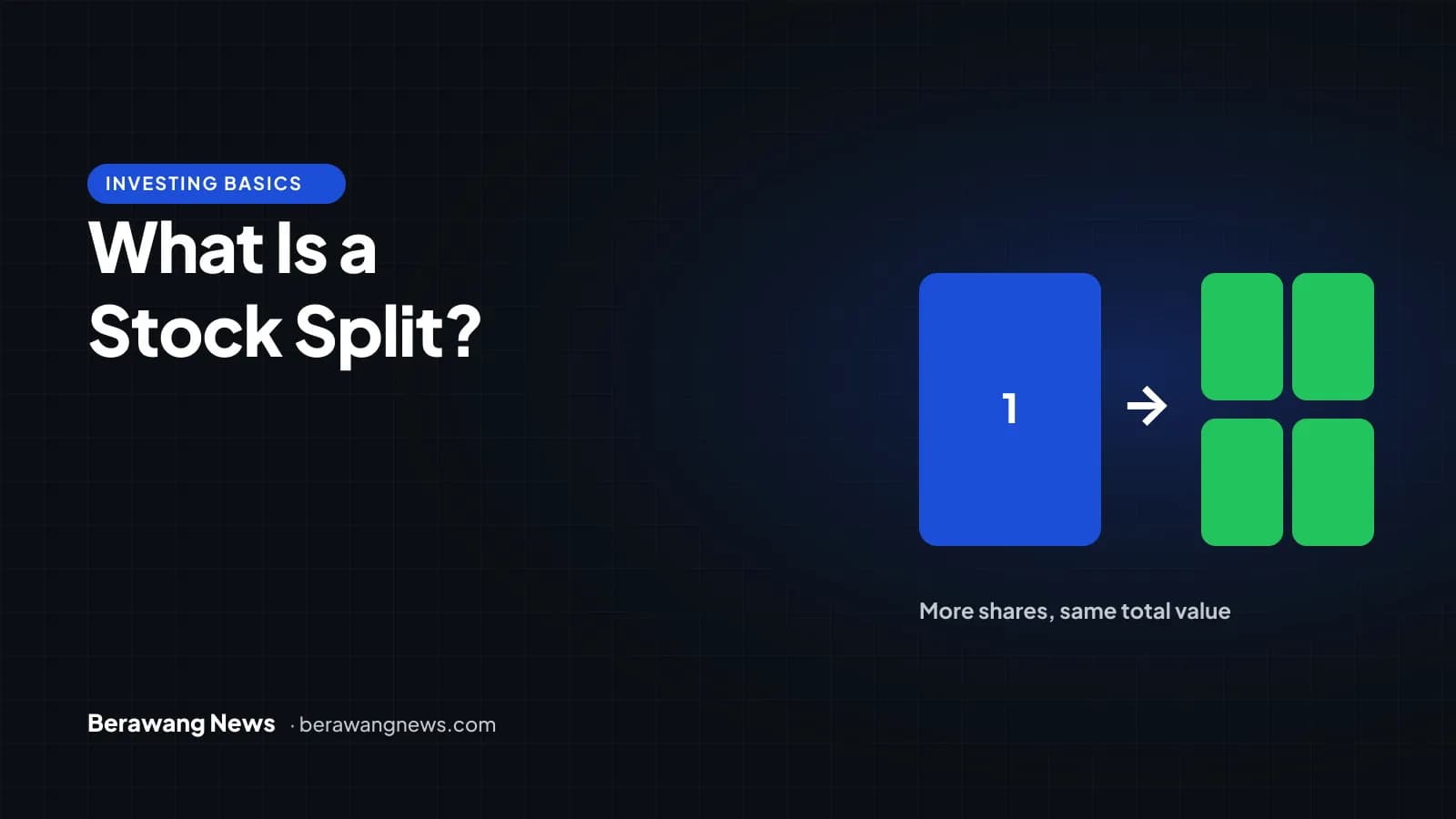
A stock split is a decision by a company’s board to change the number of its shares outstanding by issuing new shares to existing shareholders in a set proportion. After a split you own a different number of shares at a different price, but the total value of your investment stays the same, and so does the company’s market value.
How a forward stock split works
In a forward split, each share becomes several shares and the price per share drops by the same ratio.
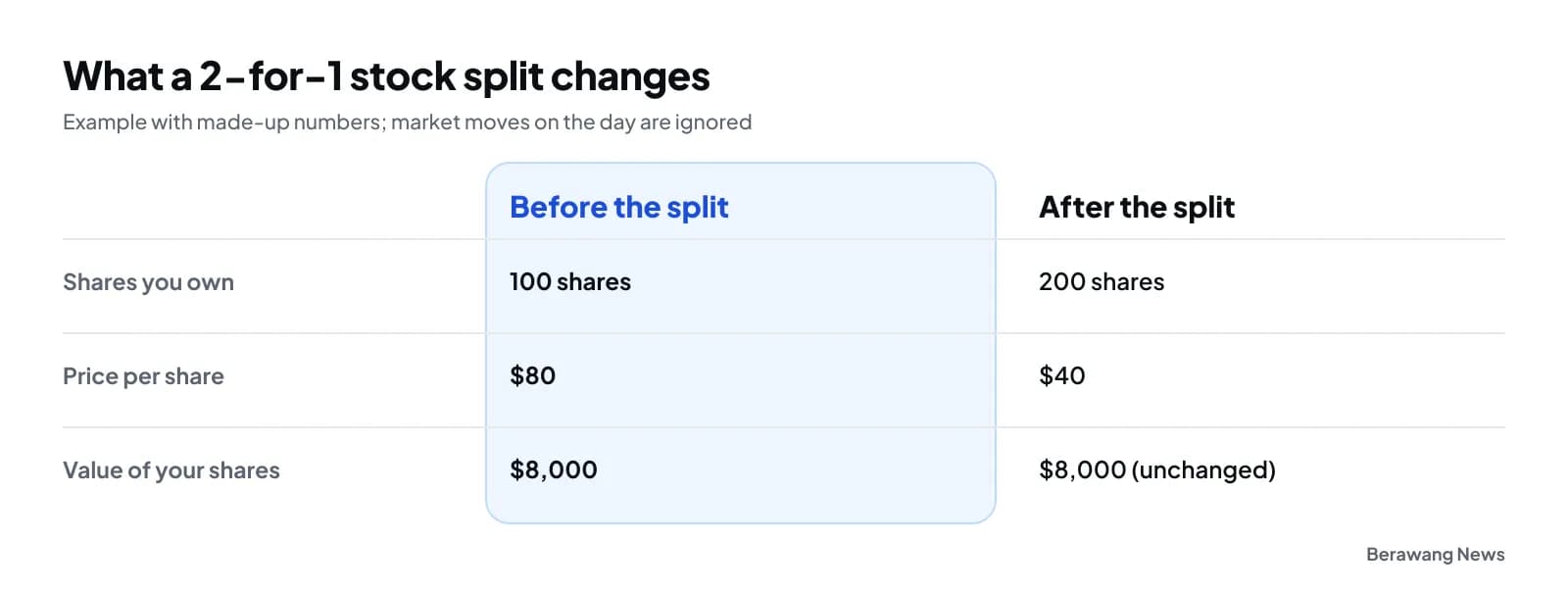
| Before a 2-for-1 split | After the split |
|---|---|---|
Shares you own | 100 | 200 |
Price per share | $80 | $40 |
Value of your shares | $8,000 | $8,000 |
Made-up numbers for illustration.
The company’s market capitalization, its share price multiplied by its shares outstanding, also stays the same. See what market cap is.
Why companies split their stock
Companies often split after a big run-up in the share price, so that each share costs less. A lower price per share can make it easier for some investors to buy whole shares, though many brokers now sell fractional shares. A split does not change the company’s profits or what the business is worth.
How a reverse stock split works
A reverse split does the opposite: several shares are combined into one, and the price per share rises. In a 1-for-10 reverse split, every 10 shares you own become 1 share, worth about 10 times as much.
FINRA’s example: 5,000 shares at 10 cents ($500 in total) become 25 shares at $20 each, still $500.
In some reverse splits, shareholders who would end up with a fraction of a share receive cash instead.
Why companies do reverse splits
The most common reason is to keep a stock listed on an exchange:
- Nasdaq requires listed stocks to keep a minimum bid price of $1.00. A company that falls below gets 180 calendar days to fix it, and must stay at or above $1 for at least 10 consecutive business days to regain compliance.
- NYSE acts when a stock’s average closing price is below $1.00 over 30 consecutive trading days, and limits how often a company can use reverse splits to get back into compliance.
Reverse splits: a warning sign to check
FINRA advises investors to “proceed with caution” when a reverse split is announced, noting that reverse splits tend to go hand in hand with low-priced, high-risk stocks. Investor.gov warns that investors may lose money from price swings after a reverse split. The SEC has also warned that some dormant shell companies use extreme reverse splits, such as 1-for-20,000, to inflate the share price as part of fraud schemes.
A reverse split isn’t always bad news, but it is worth asking why the share price fell so low. Reading the company’s earnings report is a good place to start.
What a split means for you
- You don’t need to do anything. Your broker adjusts your shares and price automatically.
- Your cost basis per share changes, but your total cost stays the same. This matters for taxes; see capital gains tax on stocks.
- Check any open orders. Ask your broker how splits affect limit or stop orders you have placed.
Frequently asked questions
Does a stock split make me money?
No. You get more shares at a lower price, and the total value is unchanged at the moment of the split.
Is a stock split a good sign?
A forward split often follows a strong rise in the share price, but the split itself doesn’t change the company’s value or outlook.
What is a reverse stock split?
It combines several shares into one at a higher price. Companies often do it to stay above an exchange’s $1 minimum price.
Do I pay tax when a stock splits?
Generally no tax is due at the time of an ordinary split; your cost basis is spread across the new number of shares. Check with a tax professional for your situation.
This guide is for education only and is not investment or tax advice.
Sources
- FINRA: Stock Splits
- Investor.gov: Reverse Stock Splits (glossary)
- FINRA: What's a Reverse Stock Split?
- SEC: Order approving Nasdaq bid price rule changes (Release No. 34-101271)
- SEC: NYSE Listed Company Manual Section 802.01C rule text (Release No. 34-102201, Exhibit 5)
- Investor.gov: Dormant Shell Companies, How to Protect Your Portfolio from Fraud