How to Start Investing in Stocks: A Beginner’s Guide
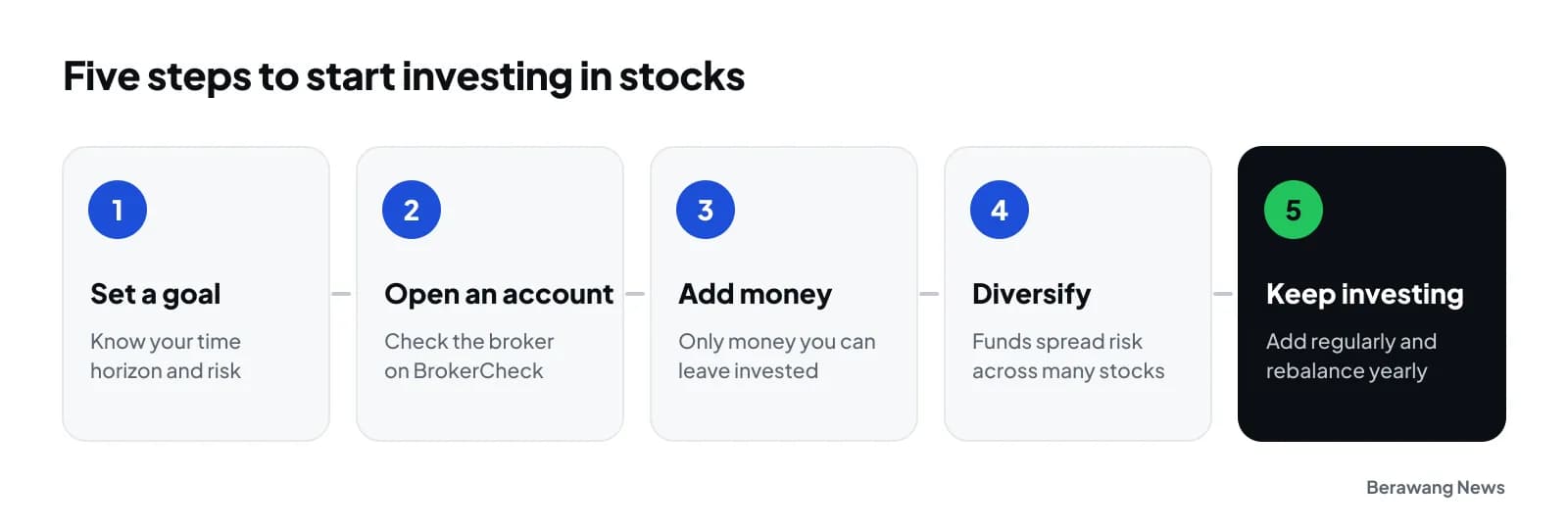
Starting to invest in stocks takes five steps: set a goal, open a brokerage account, fund it, choose diversified investments, and keep adding over time.
You can start investing in stocks with a small amount of money by following five steps: decide what you are investing for, open a brokerage account, add money, choose diversified investments, and keep investing on a regular schedule. This guide walks through each step and the risks to know before you begin.
Step 1: Know your goal and time horizon
Before buying anything, decide what the money is for and when you will need it. Money for a goal 20 or 30 years away, such as retirement, can usually ride out more ups and downs than money you need in two years for a home down payment.
The SEC’s investor education site describes two ideas that shape every decision: your time horizon (how long you plan to invest) and your risk tolerance (your ability and willingness to lose some or all of your money in exchange for potentially higher returns). Money you might need soon, and an emergency fund, generally do not belong in stocks.
Step 2: Open a brokerage account
To buy stocks you need an account with a brokerage firm. Common choices are:
- A taxable brokerage account: flexible, no limits on contributions or withdrawals, but gains and dividends are taxed.
- An individual retirement account (IRA): tax advantages for retirement savings, with yearly contribution limits and rules on withdrawals.
Before opening an account, look the firm up on FINRA BrokerCheck, a free tool that shows whether a broker is registered and any disciplinary history. Also check that the firm is a member of the Securities Investor Protection Corporation (SIPC).
SIPC protection has limits. It covers up to $500,000 per customer, including up to $250,000 in cash, if a member brokerage firm fails. It does not protect you against losses when your investments fall in value.
Step 3: Add money and set a budget
Link a bank account and transfer only money you can leave invested for years. Many brokers let you buy fractional shares, so you do not need enough to buy a whole share of an expensive stock. Check the broker’s fee schedule for commissions, account fees and transfer fees before you trade.
Step 4: Choose diversified investments
Putting all your money into one company is risky: if that company struggles, your whole investment suffers. Diversification means spreading your money across many investments to reduce risk.
For most beginners, the simplest way to diversify is a fund:
- Index funds and exchange-traded funds (ETFs) pool money from many investors and can hold hundreds of stocks in a single purchase. See our guide to what an ETF is.
- Individual stocks let you own specific companies, but you need to research each one and accept more risk.
A fund that focuses on one industry is not automatically diversified. Check a fund’s top holdings before you buy. Diversification reduces risk; it does not eliminate it.
Step 5: Keep investing and rebalance
Investing a fixed amount on a regular schedule, such as every month, builds the habit and means you buy more shares when prices are low and fewer when they are high. Use our compound interest calculator to see how regular contributions can add up over time.
Once or twice a year, check whether your mix of investments has drifted from your plan. If stocks have grown from 60% to 80% of your portfolio, for example, you can rebalance by selling some stocks or adding to other investments.
How stock trading works
U.S. stock exchanges are open for regular trading from 9:30 a.m. to 4:00 p.m. Eastern Time on weekdays, except market holidays. Learn more in our guide to stock market hours.
When you place an order, a market order buys or sells right away at the best available price, while a limit order only fills at your chosen price or better.
Common beginner mistakes
- Investing money you will need soon.
- Buying a single “hot” stock instead of diversifying.
- Selling in a panic when the market falls.
- Trading often and paying more in fees and taxes.
- Following tips from social media without checking the source.
Frequently asked questions
How much money do I need to start investing in stocks?
There is no fixed minimum. With fractional shares and funds, many people start with small amounts and add more over time.
Is investing in stocks risky?
Yes. Stock prices go up and down, and you can lose money, including your original investment. Diversification and a long time horizon can reduce, but not remove, that risk.
Should I buy individual stocks or funds?
Funds such as index funds and ETFs are an easier way to diversify. Individual stocks require more research and carry more risk.
Is my money protected if my broker goes out of business?
If the broker is a SIPC member, SIPC protection covers up to $500,000 per customer, including $250,000 in cash. It does not cover investment losses.
This guide is for education only and is not investment advice. Consider your own situation or speak with a licensed professional before investing.