What Are Dividend Stocks? How Dividends Work for Investors
Dividend stocks pay you a share of company profits, usually every quarter. Learn how dividends work, the dates that decide who gets paid, dividend yield, DRIPs and taxes.
A dividend stock is a share in a company that pays part of its profits to shareholders, usually in cash. Most U.S. companies that pay dividends do so on a regular schedule, often every quarter. Companies can also pay one-off “special” dividends.
Dividends can give you income without selling shares, but they are not guaranteed. A company decides each payment and can raise, cut or stop its dividend.
How dividends work
When a company’s board approves a dividend, it announces the amount per share and the key dates. If you own the stock by the right date, the cash is deposited in your brokerage account on the payment date.
Example: you own 200 shares and the company pays $0.50 per share each quarter. You receive $100 per quarter, or $400 a year, as long as the dividend stays the same.
The four dividend dates
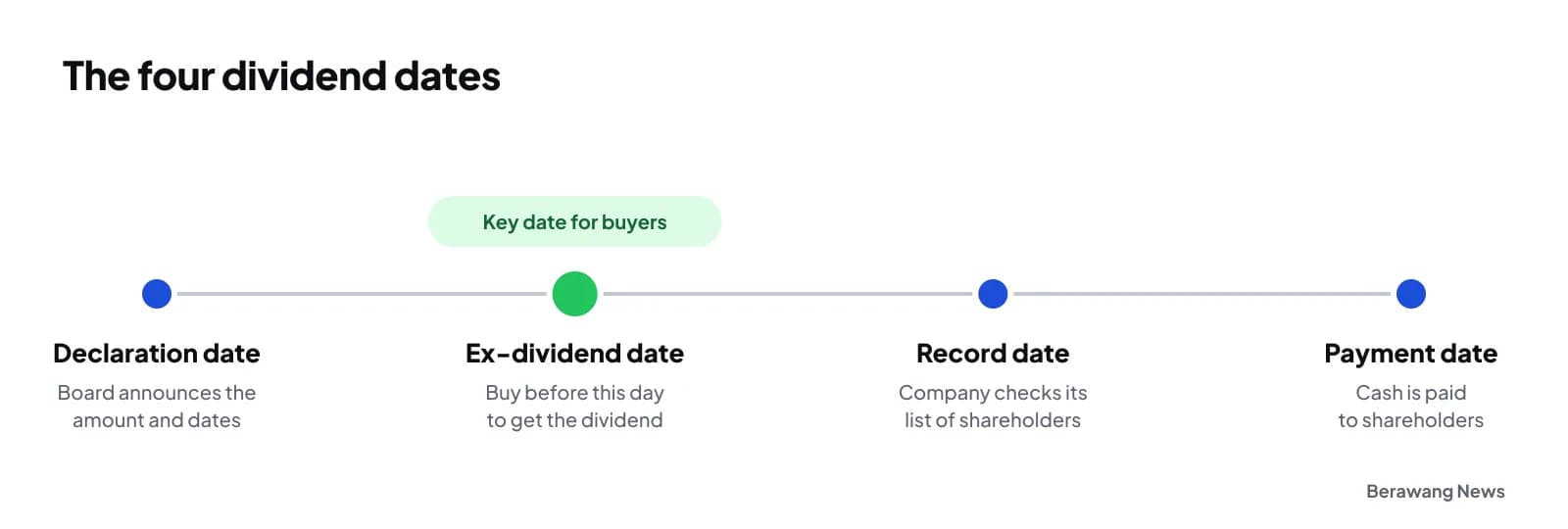
- Declaration date: the company announces the dividend amount and its dates.
- Ex-dividend date: the cutoff for buyers. If you buy the stock on or after this date, you will not receive the next dividend. For most stocks, it is the same day as the record date (or one business day earlier if the record date is not a business day).
- Record date: you must be on the company’s books as a shareholder by this date to be paid.
- Payment date: the dividend is paid.
Investor.gov notes one exception: for very large special dividends (25% or more of the stock’s value), the ex-dividend date is set one business day after the dividend is paid.
Dividend yield
Dividend yield compares the yearly dividend with the share price:
Dividend yield = annual dividend per share ÷ share price
A stock trading at $50 that pays $2 a year has a 4% yield. Because yield moves with the price, a very high yield can be a warning sign: it can mean the share price has fallen because investors worry the dividend will be cut.
Try different numbers with our dividend calculator.
Dividend reinvestment plans (DRIPs)
A DRIP automatically uses your dividends to buy more shares of the same stock, often without commissions, and some plans even offer a small discount. You can sign up with the company or, often, through your broker or fund. Reinvesting lets your holdings compound over time; see how with our compound interest calculator.
How dividends are taxed
- Dividends are taxable even if you reinvest them. The IRS says reinvested dividends must be reported as income.
- Ordinary dividends are taxed as ordinary income.
- Qualified dividends are ordinary dividends that qualify for the lower capital gains tax rates. For common stock, one key rule is the holding period: you must hold the stock for more than 60 days during the 121-day period that begins 60 days before the ex-dividend date.
- Your broker reports dividends to you and the IRS on Form 1099-DIV.
Dividends paid inside a retirement account such as an IRA follow that account’s tax rules instead. See Roth IRA vs. traditional IRA.
What to check before buying a dividend stock
- Dividend history: has the company paid steadily, and has it raised the dividend over time?
- Payout ratio: the share of profits paid out as dividends. A ratio near or above 100% may be hard to sustain.
- Earnings and cash flow: dividends are paid from cash, so check the company’s earnings report.
- Diversification: don’t chase yield in one company or sector. A dividend ETF spreads the risk across many companies.
Frequently asked questions
How often are dividends paid?
Most U.S. companies that pay dividends pay quarterly, though some pay monthly, twice a year or once a year.
Do I get the dividend if I buy on the ex-dividend date?
No. You must buy before the ex-dividend date to receive the next dividend.
Are dividends guaranteed?
No. A company can reduce, suspend or stop its dividend at any time.
Do I pay tax on reinvested dividends?
Yes. Reinvested dividends are reported as income, just like cash dividends, unless they are inside a tax-advantaged account.
This guide is for education only and is not investment or tax advice.