What Is a Mutual Fund? How Mutual Funds Work, Fees and Types
A mutual fund pools money from many investors to buy stocks, bonds or other assets. Learn how NAV pricing works, how you earn money, the fees to watch and how funds differ from ETFs.
A mutual fund is a company that pools money from many investors and invests it in stocks, bonds, short-term money market instruments or a mix of them. When you buy a share of a mutual fund, you own a small slice of everything the fund holds, along with its gains and losses. A professional investment adviser registered with the SEC manages the portfolio.
You can hold them in a regular brokerage account or in tax-advantaged accounts such as a 401(k) or IRA. This guide explains how they work in plain English, using information from the SEC's investor education site, Investor.gov.
How a mutual fund works
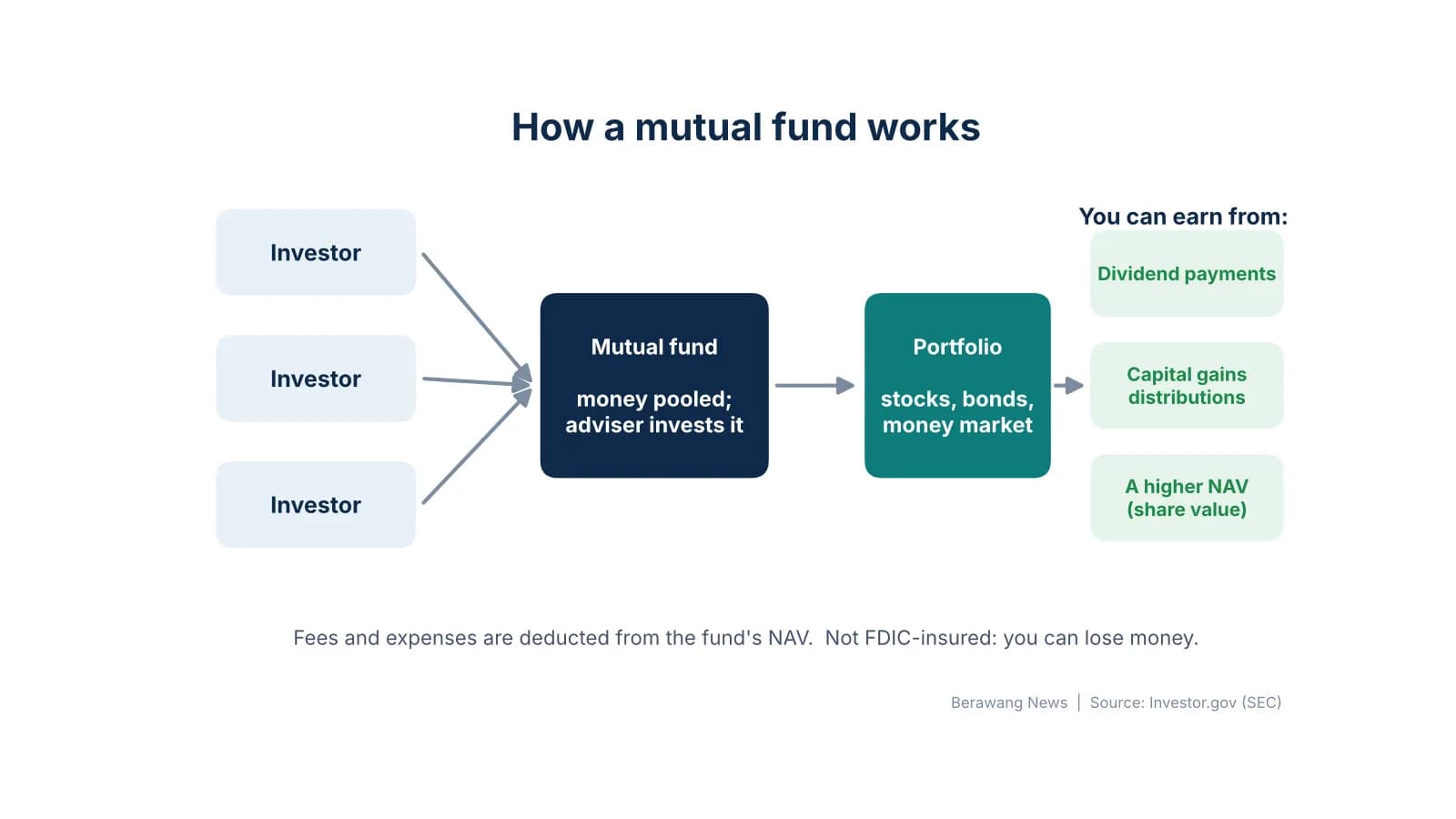
The SEC describes a mutual fund as a registered "open-end" investment company whose shares are redeemable: you do not trade with another investor on a stock exchange; you buy from and sell back to the fund itself, or through a broker or adviser.
Here is the basic flow:
- Thousands of investors send money to the fund.
- The fund's adviser invests that pool according to the fund's stated goal, such as tracking a stock index or earning bond income.
- The fund's value rises or falls with its holdings, and fees are deducted from the fund's assets.
- Investors share the results in proportion to the shares they own.
What is NAV, and when is the price set?
A mutual fund's price is its net asset value (NAV) per share, which reflects the value of the fund's portfolio, with the fund's fees and expenses already deducted. According to an Investor.gov bulletin comparing mutual funds and ETFs, NAV is typically calculated at the end of each business day.
That has a practical effect: when you place an order during the day, you get the next calculated NAV, plus any purchase fees. When you sell (the industry calls it "redeeming"), you receive the next calculated NAV, minus any fees. So you will not know the exact price per share until the end of the trading day. This is very different from a stock or an ETF, which trades at changing market prices all day long.
Three ways you can make money
Investor.gov lists three ways mutual fund investors can earn a return:
Source of return | What it is | When you get it |
|---|---|---|
Dividend payments | Income the fund earns from its holdings, such as stock dividends or bond interest, passed on to you after expenses | Whenever the fund pays it out |
Capital gains distributions | Profits the fund makes when it sells holdings for more than it paid, after subtracting capital losses | Usually once a year, near year-end |
Higher NAV | The value of the fund's holdings goes up, so each share is worth more | When you sell your shares |
In a taxable brokerage account, Investor.gov notes that mutual fund investors generally have to pay taxes on capital gains distributions. Read our guide to capital gains tax on stocks for how gains are taxed.
Main types of mutual funds
- Stock funds invest mainly in company shares.
- Bond funds invest mainly in debt securities, and their risk and return depend on the kinds of bonds they hold. The SEC notes that when market interest rates rise, prices of fixed-rate bonds fall.
- Money market funds invest in liquid, short-term debt, cash and cash equivalents. Like other mutual funds, they are not FDIC-insured.
- Target date funds hold a mix of other funds that shifts as a target date approaches. Because they invest in other funds, they can carry an extra layer of fees.
Funds also differ by strategy. Index funds passively track a market index, while actively managed funds have managers who pick investments trying to beat the market. For the details, see index funds vs. ETFs.
Fees: the part most beginners miss
Fees come out of your returns every year, so they matter. A mutual fund's prospectus has a fee table with two parts.
Annual operating expenses, taken from the fund's assets:
- Management fees paid to the fund's investment adviser.
- 12b-1 fees, named after the SEC rule that authorizes them.
- Other expenses of running the fund.
Added together and stated as a percentage of the fund's average net assets, these make up the expense ratio.
Shareholder fees, charged when you buy, sell or hold:
- Sales loads, which work like a commission to the selling broker. A front-end load is charged when you buy: with a 5% front-end load, a $10,000 investment pays a $500 sales load, leaving $9,500 actually invested. A back-end load (contingent deferred sales load) is charged when you sell and may shrink to zero the longer you hold.
- Purchase, redemption, exchange and account fees, which some funds charge.
A no-load fund charges no sales load. But as the SEC puts it, no-load does not mean no fees: these funds still have operating expenses and may charge other shareholder fees.
Share classes
The same fund can sell several share classes that own the same portfolio but carry different fees, so their returns differ. Class A shares might have a front-end load (sometimes discounted at "breakpoints" for larger purchases) and a lower 12b-1 fee. Class C shares might have a 12b-1 fee and a back-end load for some period, often a year; because of their higher 12b-1 fee, you could end up paying more if you hold them a long time. Class B shares, once common, are no longer widely available.
To see how much fees can add up, try our compound interest calculator with and without a 1% yearly fee.
Mutual funds vs. ETFs
Feature | Mutual fund | ETF |
|---|---|---|
How you buy and sell | From the fund or through a broker or adviser | On a stock exchange, through a brokerage account |
Price | Next NAV, usually set once at the end of the day | Market price that changes all day; can be above or below NAV |
Capital gains distributions | More common than with ETFs; taxable in a taxable account | Typically fewer, thanks to in-kind exchanges |
Shareholder fees such as loads | Some funds charge them | Uncommon, but brokerage commissions may apply |
Inside a tax-advantaged account such as an IRA or 401(k), Investor.gov notes there is no tax difference between the two.
Benefits and risks
Benefits: professional management, instant diversification across many holdings, low minimum investments at many funds, and the ability to sell your shares on any business day.
Risks: mutual funds are not guaranteed or insured by the FDIC or any other government agency, and you can lose some or all of the money you invest. A fund is only as good as what it holds, and high fees can quietly eat into returns over time.
Frequently asked questions
Is a mutual fund a good investment for beginners?
A mutual fund can be a simple way to get professional management and diversification, because one purchase spreads money across many holdings. Whether a particular fund fits depends on your goals, timeline and its fees. Our Investing 101 guide walks through the steps.
Can you lose money in a mutual fund?
Yes. Mutual funds are not insured by the FDIC or any government agency, and their value moves with the stocks, bonds or other assets they hold.
Why can't I see a mutual fund's price during the day?
Mutual funds are bought and sold at their NAV, which is typically calculated once, at the end of each business day. Your order fills at the next NAV calculated after you place it.
What is a good expense ratio?
Lower costs leave more of the return for you. Compare a fund's expense ratio with similar funds, and check its prospectus fee table for sales loads and other charges.
This guide is for education only and is not investment advice. All investing involves risk, including the possible loss of your money.
Sources
- Investor.gov (SEC): Mutual Funds
- Investor.gov (SEC): Mutual Fund and ETF Fees and Expenses – Investor Bulletin
- Investor.gov (SEC): Updated Investor Bulletin: Mutual Fund Classes
- Investor.gov (SEC): Characteristics of Mutual Funds and Exchange-Traded Funds (ETFs)
- Investor.gov (SEC): Fixed Income Investments – When Interest Rates Go Up, Prices of Fixed-Rate Bonds Fall