Index Funds vs. ETFs: What's the Difference?
Index funds and ETFs both offer low-cost diversification, and many ETFs are index funds. Learn how index mutual funds and ETFs differ in pricing, trading, minimums, fees and taxes.
“Index fund vs. ETF” is a bit of a trick question. An index fund is any fund that tracks a market index, and it can be a mutual fund or an ETF. So the real choice is usually between an index mutual fund and an index ETF. Both give you a slice of hundreds or thousands of companies at low cost; the differences are in how you buy, sell and pay for them.
What is an index fund?
Investor.gov defines an index fund as a mutual fund, ETF or unit investment trust that follows a passive strategy: it aims to earn about the same return as a particular index, such as the S&P 500, before fees. Because the fund simply follows the index, it usually trades less and charges lower fees than actively managed funds, although Investor.gov notes that not every index fund is cheaper.
Index mutual fund vs. index ETF
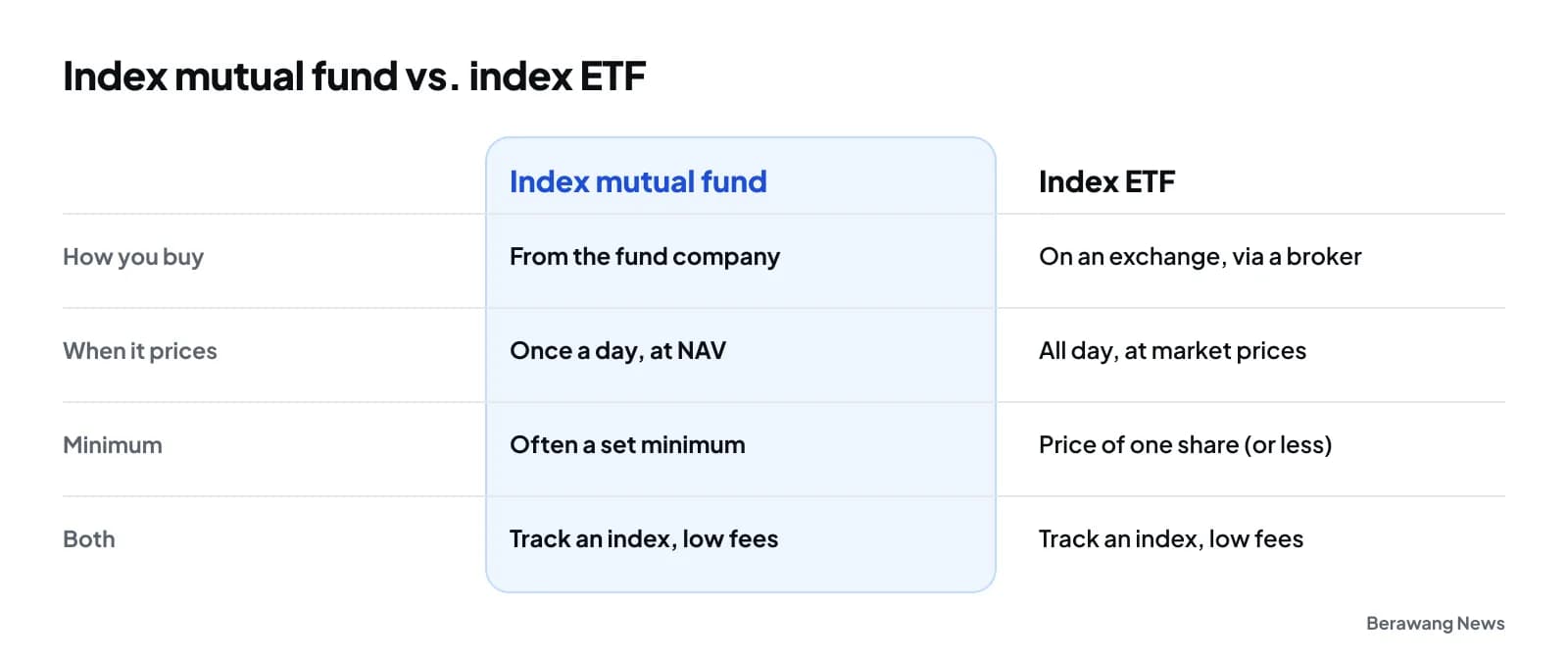
| Index mutual fund | Index ETF |
|---|---|---|
How you buy | From the fund company or through a broker | On a stock exchange, through a broker |
Price | Net asset value (NAV), calculated once a day after the market closes | Market price, which changes all day and can be a bit above or below NAV |
When your order fills | At the next NAV, after the close | During the trading day, like a stock |
Minimum investment | Often a set dollar minimum | Price of one share, or less with fractional shares |
Taxes | Can distribute capital gains | Can sometimes be more tax efficient |
Both types track an index and are diversified. For a deeper look at how ETFs work, see what an ETF is.
Fees matter more than you think
Every fund charges an expense ratio: the percentage of the fund’s assets used each year to pay its operating costs. You will find it in the fund’s prospectus fee table.
The SEC’s investor bulletin on fees shows how much small differences add up. In its example, $100,000 growing 4% a year for 20 years ends at about $208,000 with a 0.25% annual fee, but only about $179,000 with a 1.00% fee. That is nearly $30,000 lost to fees.
Try your own numbers with our compound interest calculator.
Which should you choose?
- Choose an index mutual fund if you want to invest a fixed dollar amount automatically, for example every payday, and your fund company makes that easy.
- Choose an index ETF if you want to trade during the day, start with a small amount, or keep everything in one brokerage account.
- In a 401(k), you usually choose from the plan’s mutual funds; see what a 401(k) is.
Whichever you pick, compare the expense ratio, the index it tracks and how closely it has followed that index.
Frequently asked questions
Is an S&P 500 ETF an index fund?
Yes. An ETF that tracks the S&P 500 is an index fund in ETF form.
Are index funds safe?
They are diversified, but they still move with the market and can lose value. Diversification reduces the risk of any one company hurting you; it doesn’t remove market risk.
Why do ETFs trade at a different price than their NAV?
An ETF’s market price is set by buyers and sellers during the day, so it can be slightly higher or lower than the value of the fund’s holdings.
What is a good expense ratio?
Lower is better. Compare funds that track the same index; differences of even a fraction of a percent add up over decades.
This guide is for education only and is not investment advice.
Sources
- Investor.gov: Index fund (glossary)
- Investor.gov: Index Funds
- Investor.gov: Exchange-traded fund (ETF) (glossary)
- Investor.gov: Net asset value (glossary)
- Investor.gov: Characteristics of Mutual Funds and Exchange-Traded Funds (Investor Bulletin)
- Investor.gov: Expense ratio (glossary)
- Investor.gov: How Fees and Expenses Affect Your Investment Portfolio (Investor Bulletin)