How to Buy Bitcoin Safely: A Step-by-Step Guide for Beginners
Buying bitcoin is easy; buying it safely takes a few extra checks. Here is how to pick a platform, avoid common scams, protect your account and understand the taxes.
Buying bitcoin takes only a few minutes on most crypto apps. Buying it safely means checking who you are dealing with, protecting your account, and knowing that the safety nets you may expect from a bank or brokerage usually don’t apply. This guide walks through each step.
Bitcoin prices can swing sharply. The CFTC warns that the digital asset market is “largely unregulated and fraud is a significant risk.” Only invest money you can afford to lose.
Step 1: Decide how you want to own bitcoin
There are two common routes:
- Buy bitcoin directly on a crypto trading platform. You own the coins themselves and must keep them safe, either on the platform or in your own crypto wallet.
- Buy a spot bitcoin exchange-traded product (ETP) through a regular brokerage account. The SEC approved the listing of spot bitcoin ETPs on January 10, 2024. You get price exposure without holding bitcoin yourself, but the SEC notes that a share’s price can differ from bitcoin’s price and that sponsor fees reduce the amount of bitcoin each share represents over time.
Not sure how exchange-traded products work? Read what an ETF is first.
Step 2: Choose a registered platform
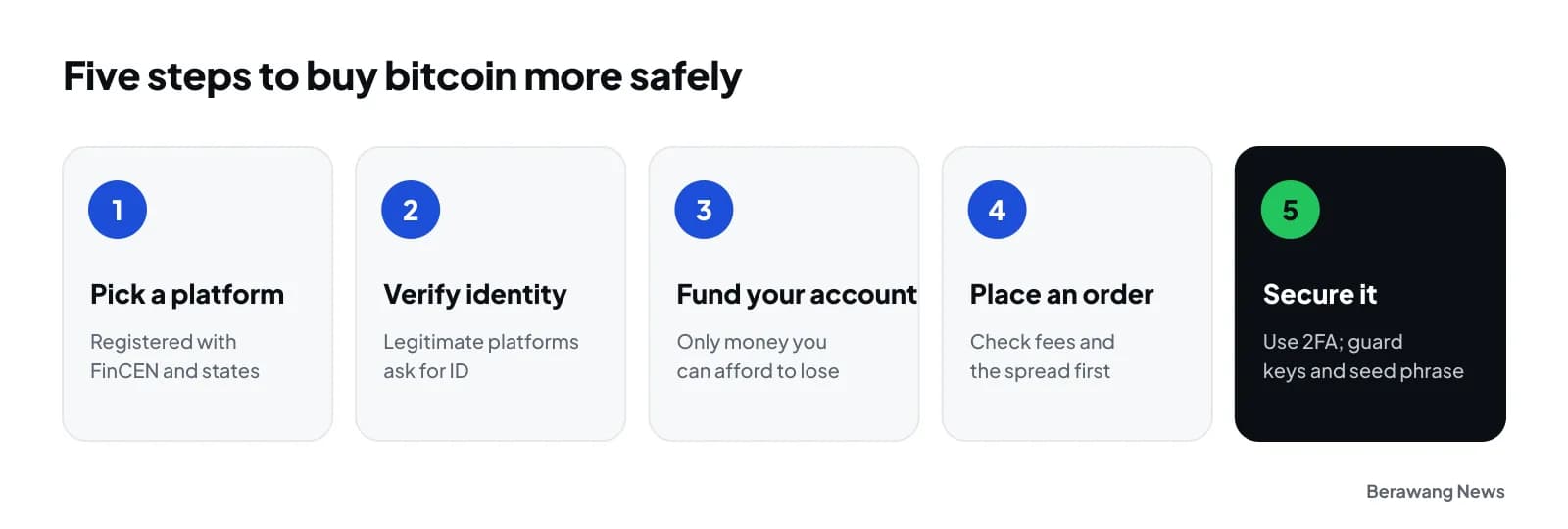
Under FinCEN guidance, businesses that exchange virtual currency are generally money transmitters and must register with FinCEN as a money services business (MSB). Before you sign up:
- Check that the platform is registered with FinCEN or your state’s licensing system, as the CFTC advises. Registration alone doesn’t guarantee a platform is safe.
- Type the platform’s web address yourself. The FBI has warned about fake sites that use look-alike domain names of real exchanges.
- Read how the platform holds customer assets and what happens if it fails.
Step 3: Know what is (and isn’t) protected
This is the biggest difference from a bank or stock brokerage:
- SIPC does not protect digital assets that are not securities, even at a SIPC-member firm.
- FDIC insurance does not cover crypto assets and does not protect you if a crypto exchange, custodian or wallet provider goes bankrupt.
- The SEC warns that crypto platforms “may lack important protections for investors.”
Step 4: Fund your account and place an order
- Verify your identity. Legitimate U.S. platforms ask for ID.
- Add money from your bank account.
- Before you buy, check the trading fee and the spread (the gap between the buy and sell price).
- Start small. A limit order lets you set the most you will pay.
Step 5: Secure your account and your coins
- Turn on multi-factor authentication and use a unique password.
- Never share your password, private keys or seed phrase. No real support agent will ask for them.
- For larger, long-term amounts, consider moving coins to a wallet you control. Our guide on hot vs. cold wallets explains the tradeoffs.
How to spot a bitcoin scam
Regulators keep seeing the same patterns:
- “Pig butchering” and romance scams: a new online friend or match guides you to a trading site that shows big fake gains, then blocks withdrawals until you pay “taxes” or “fees.” The CFTC’s advice: never pay more money to get your money back.
- Impersonators: people posing as businesses, government agencies or tech support who tell you to convert money to crypto. The FTC says anyone who insists on payment in crypto is probably a scammer.
- Social media pitches: the FTC found nearly half of reported crypto scam losses from January 2021 to March 2022 started on social media.
- Guaranteed returns: no legitimate investment can promise them.
Crypto payments usually can’t be reversed, so stop before you send. Report fraud to the FBI at ic3.gov or to the CFTC at cftc.gov/complaint.
Bitcoin and taxes
The IRS treats digital assets as property, not currency. When you sell, trade or spend bitcoin, you generally have a capital gain or loss, short-term if you held it for one year or less and long-term if longer. Form 1040 asks every filer a digital asset question, and U.S. brokers began reporting digital asset sales on Form 1099-DA for transactions on or after January 1, 2025.
Frequently asked questions
What is the safest way to buy bitcoin?
Use a platform registered with FinCEN or your state, type its address yourself, turn on multi-factor authentication, and never share your keys or seed phrase. A spot bitcoin ETP bought through a brokerage is another route.
Is bitcoin insured like a bank deposit?
No. FDIC insurance does not cover crypto assets, and SIPC does not protect digital assets that are not securities.
How much bitcoin should a beginner buy?
There is no right amount. Regulators describe bitcoin as highly speculative, so only invest money you can afford to lose.
Can I get my bitcoin back if I’m scammed?
Crypto transfers usually can’t be reversed. Report it to ic3.gov and cftc.gov/complaint, and ignore anyone who offers to recover your money for a fee.
This guide is for education only and is not investment advice. Crypto assets are volatile and you can lose your entire investment.
Mentioned in this article
Sources
- Investor.gov: Exercise Caution with Crypto Asset Securities (SEC investor alert, March 2023)
- CFTC: Digital Assets
- CFTC: Customer Advisory on Romance Scams Involving Digital Assets
- FinCEN: Guidance on Convertible Virtual Currencies (FIN-2019-G001)
- SIPC: What SIPC Protects
- FDIC: Fact Sheet, What the Public Needs to Know About FDIC Deposit Insurance and Crypto Companies
- FBI IC3: Cryptocurrency Investment Fraud (PSA, October 2022)
- FTC: Reports Show Scammers Cashing In on Crypto Craze (June 2022)
- SEC: Statement on the Approval of Spot Bitcoin ETPs (January 10, 2024)
- Investor.gov: ETPs Providing Exposure to Bitcoin and Ether (Investor Bulletin, September 2024)
- IRS: Digital Assets
This article is for information only and is not investment advice. Do your own research before buying or selling any asset.