What Is a Crypto Wallet? Hot vs. Cold Wallets Explained
A crypto wallet doesn't hold your coins. It holds the keys that control them. Learn how private keys and seed phrases work, and when to use a hot or cold wallet.
A crypto wallet is a device or program that stores the keys to your crypto, not the crypto itself. Your coins are recorded on a blockchain; the wallet holds the secret key that proves they are yours and lets you send them. Lose that key and, as the SEC puts it, you “permanently lose access” to the assets.
Private keys, public keys and seed phrases
- Private key: a randomly generated passcode that authorizes transactions. FINRA compares it to a password. Anyone who has it can move your crypto.
- Public key (or address): what you share to receive crypto, much like an email address.
- Seed phrase: a random list of words that can restore your wallet if your device is lost or broken. FINRA calls it your “emergency backup.”
Never share your private key or seed phrase with anyone, including someone who says they work for a wallet or exchange.
Hot wallets vs. cold wallets
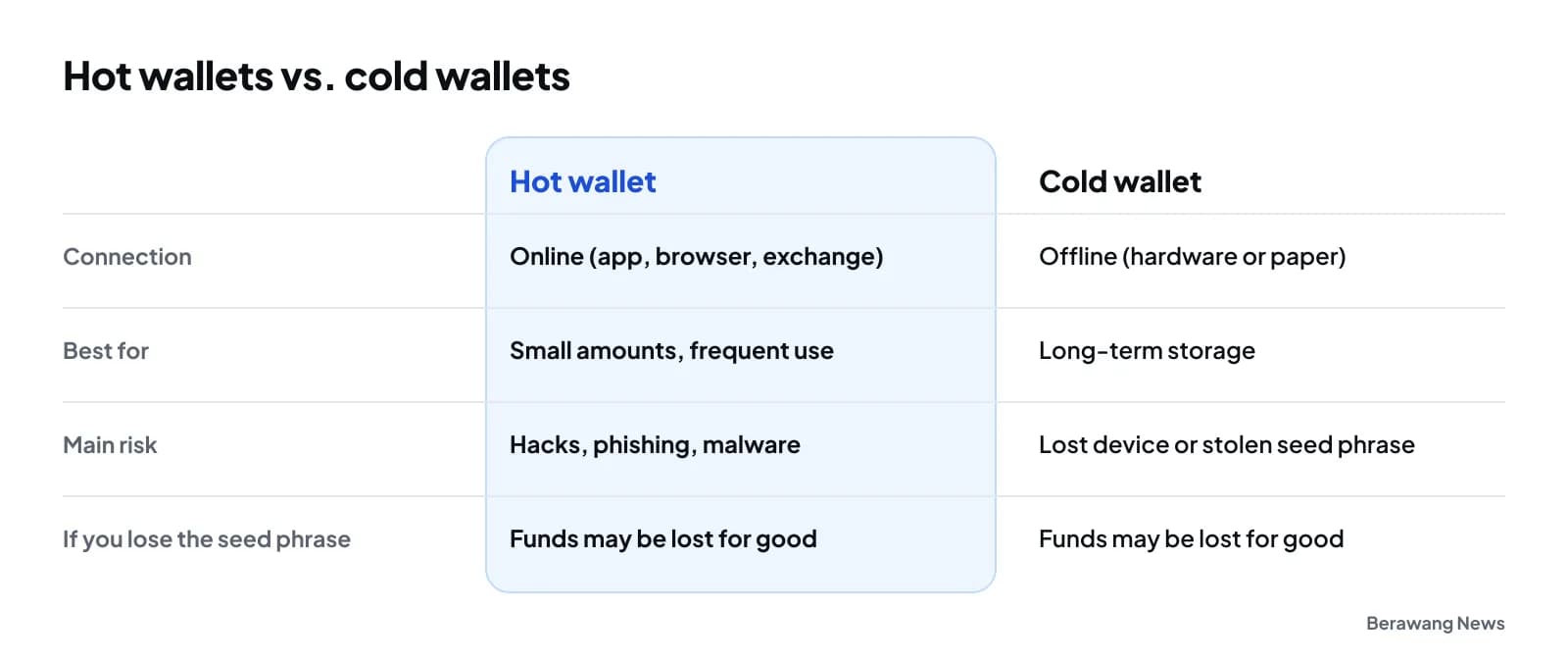
| Hot wallet | Cold wallet |
|---|---|---|
Connection | Online: desktop, mobile or web app | Offline: hardware device or paper |
Convenience | Easy for frequent use | Less convenient |
Main risk | Hackers, malware and phishing | Device lost, damaged or stolen |
Good for | Small amounts you use often | Larger amounts held long term |
Both the SEC and FINRA describe hot wallets as convenient but more exposed to online attacks, and cold wallets as generally safer from those attacks but at risk of loss or damage. FINRA adds that cold wallets are not immune to sophisticated attacks.
Self-custody vs. letting an exchange hold your crypto
- Self-custody (unhosted wallet): you control the keys and are solely responsible for them. No company can freeze or lose your coins, but no one can recover them for you either.
- Third-party custody (hosted wallet): an exchange or custodian holds the keys for you. The SEC notes the risk that the custodian is hacked, shuts down or goes bankrupt.
If you use a custodian, the SEC suggests asking whether it lends out or mixes customer assets with its own, and whether it carries insurance. FDIC insurance does not protect you if a crypto company fails.
How to keep your crypto wallet safe
- Back up your seed phrase offline. FINRA advises against storing keys or seed phrases in internet-connected files such as cloud drives, and suggests a safe or a bank safe deposit box.
- Turn on multi-factor authentication for any app or exchange account.
- Watch for phishing. Thieves usually get keys through impostors, malware or fake sites, not by breaking encryption.
- Buy hardware wallets from the maker or a trusted seller, and set them up yourself.
- Send a small test amount first when moving crypto to a new address.
Ready to buy your first coins? Read how to buy bitcoin safely.
Frequently asked questions
Do I need a crypto wallet to buy bitcoin?
No. Most exchanges hold your coins in a hosted wallet for you. A wallet of your own gives you control of the keys, along with full responsibility for them.
What happens if I lose my seed phrase?
If you also lose access to your device, you may lose the crypto permanently. There is no password reset in self-custody.
Is a hardware wallet the same as a cold wallet?
A hardware wallet is the most common type of cold wallet. Paper wallets are another type.
Are hot wallets safe?
They are fine for small amounts you use often, but because they are online they face more risk from hackers, malware and phishing.
This guide is for education only and is not investment advice.