What Are Treasury Bills? How T-Bills Work and How to Buy Them
Treasury bills are short-term U.S. government debt sold at a discount and paid at face value. Learn the terms, the $100 minimum, how interest and taxes work, and how to buy them.
A Treasury bill, or T-bill, is a short-term loan you make to the U.S. government. You buy the bill for less than its face value, and when it matures, the government pays you the full face value. The difference is your interest. Bills last from a few weeks to one year, and you can buy one for as little as $100.
Treasury securities are "backed by the full faith and credit of the U.S. government," according to the SEC's investor education site, Investor.gov, which calls them "one of the safest investments." This guide explains how T-bills work in plain English, using information from TreasuryDirect, the IRS and Investor.gov.
How a Treasury bill works
T-bills pay interest only once, at maturity. TreasuryDirect explains that bills are typically issued at a discount from their par amount, also called face value. Your interest is simply the face value minus the price you paid.
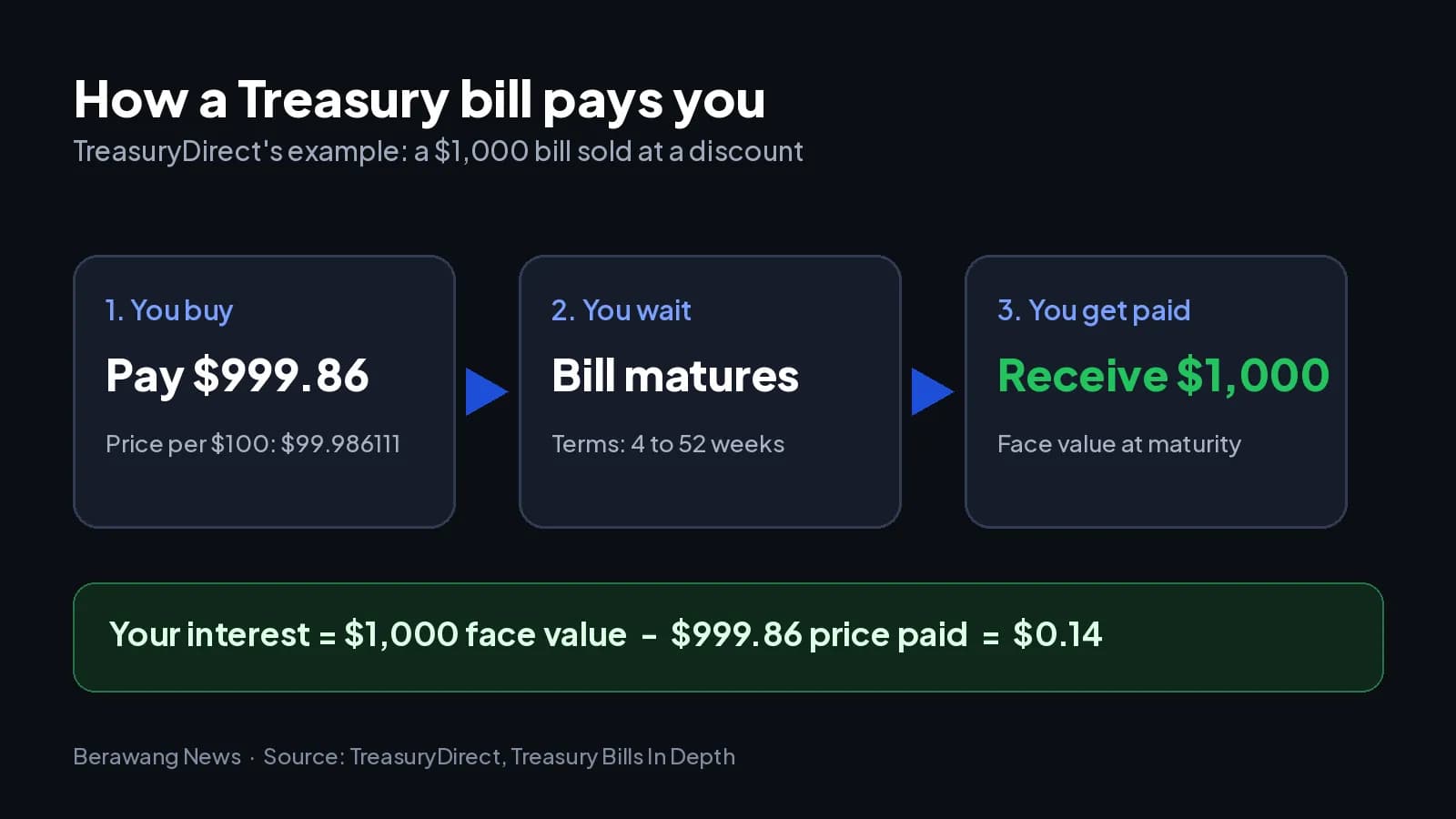
TreasuryDirect gives this example. Suppose a $1,000 bill sells at a price of $99.986111 per $100 of face value. You would pay $999.86 ($1,000 × 0.99986111, rounded to the nearest penny). When the bill matures, you receive $1,000. Your interest is the $0.14 difference.
That example uses a very small discount. The real price of each bill is set at auction, so the discount, and your return, depends on the interest rates investors accept at that time. A bill can also sell at its full face value.
Terms, auctions and limits
Here are the key facts about bills, from TreasuryDirect's "Treasury Bills In Depth" page:
Feature | Details |
|---|---|
Terms | 4, 8, 13, 17, 26 and 52 weeks |
Minimum purchase | $100 |
Increments | $100 |
Interest | Paid at maturity (face value minus price paid) |
How often sold | Weekly for all terms except the 52-week bill, which is auctioned every four weeks |
Noncompetitive limit | Up to $10 million per auction |
Form | Electronic only |
Where to buy | TreasuryDirect, or a bank or broker |
There is also a special type called a cash management bill. These have variable terms, are not auctioned on a regular schedule and cannot be bought in TreasuryDirect, only through a bank or broker.
Competitive vs. noncompetitive bids
The Treasury sells bills at auction, and you can bid in one of two ways:
- Noncompetitive bid. You agree to accept the discount rate set at the auction. In return, you are guaranteed to get the bill you want, in the full amount you want. It is the only kind of bid you can place in TreasuryDirect.
- Competitive bid. You state the discount rate you are willing to accept. Competitive bids must go through a bank, broker or dealer, and a bidder can buy up to 35% of the initial offering amount this way.
TreasuryDirect's FAQs say you can bid either way in an auction, but not both in the same auction.
How to buy T-bills
You have two main routes:
- TreasuryDirect. You open an online account with the Treasury and place noncompetitive bids at auction. Your bills are held in that account.
- A bank or broker. You buy through a financial institution, either at auction or from other investors in the secondary market. Bills bought this way are held in the commercial book-entry system, and TreasuryDirect notes that a broker or bank may charge fees.
If you already have a brokerage account, buying a T-bill there can feel similar to buying a stock or fund. Our guide on how to start investing in stocks explains how to open one.
Can you sell a T-bill early?
Yes. TreasuryDirect says you can hold a bill until it matures or sell it before then, because bills are transferable in the secondary market. Keep in mind that if you sell early, you get whatever another investor will pay at that moment, which may not match what you paid plus the interest you expected. If you hold to maturity, you receive the full face value.
When a bill matures in TreasuryDirect, you can choose to roll the money into another security by scheduling it to reinvest, according to TreasuryDirect's FAQs.
How T-bills are taxed
T-bills have a tax advantage that many savers like. The IRS says interest from Treasury bills, notes and bonds "is subject to federal income tax but is exempt from all state and local income taxes." TreasuryDirect's tax page states the same rule.
For a bill, the taxable "interest" is the difference between the price you paid and the face value you receive. TreasuryDirect reports this on IRS Form 1099-INT. If a bill matures on December 31 and that day falls on a weekend or holiday, you are paid on the next business day, but TreasuryDirect says it still shows the payment on your 1099-INT on the day the bill matures, not the year it is paid. The IRS notes that you must report all taxable interest on your federal return even if you do not receive a Form 1099-INT.
This is different from profits on stocks, which follow capital gains rules. See our guide to capital gains tax on stocks for comparison.
T-bills compared with other ways to hold cash
T-bills are one of several places people park money they may need within a year. Money market funds are another common choice; our guide to mutual funds explains how they work. With a T-bill you own the government debt directly, you know the face value you will receive at maturity, and you choose the term.
The trade-off is that your money is tied up until the bill matures unless you sell it, and the rate you get is set by each auction. Use our compound interest calculator to see how reinvesting interest over time can add up.
Frequently asked questions
What is the minimum amount to buy a Treasury bill?
The minimum purchase is $100, and you can buy more in $100 increments, according to TreasuryDirect. With a noncompetitive bid, you can buy up to $10 million in bills in a single auction.
How long do Treasury bills last?
TreasuryDirect lists terms of 4, 8, 13, 17, 26 and 52 weeks. Cash management bills, sold only through banks and brokers, have variable terms.
Do you pay state tax on T-bill interest?
No. The IRS says interest on Treasury bills is subject to federal income tax but exempt from all state and local income taxes.
Are Treasury bills safe?
Investor.gov says Treasury securities are backed by the full faith and credit of the U.S. government and are considered one of the safest investments. If you sell before maturity, though, the price you get depends on the market at that time.
For more step-by-step learning, see our Investing 101 guide.
This guide is for education only and is not investment advice. All investing involves risk, including the possible loss of your money.