Daftar Isi
The leaders of Intel and Broadcom, two of the companies profiting most from the artificial intelligence buildout, say the biggest near-term threat to that boom is not a shortage of chips or engineers. It is money. Speaking in Singapore on Monday, both executives pointed to the rising cost and limited supply of financing as the factor most likely to slow the industry’s spending spree.
“The biggest constraint is capital,” Broadcom CEO Hock Tan said at the DBS Asia Future Forward Conference. Intel CEO Lip-Bu Tan raised a similar concern, pointing to both the price of borrowing and the pressure on AI companies to prove, over time, that their investments will pay off.
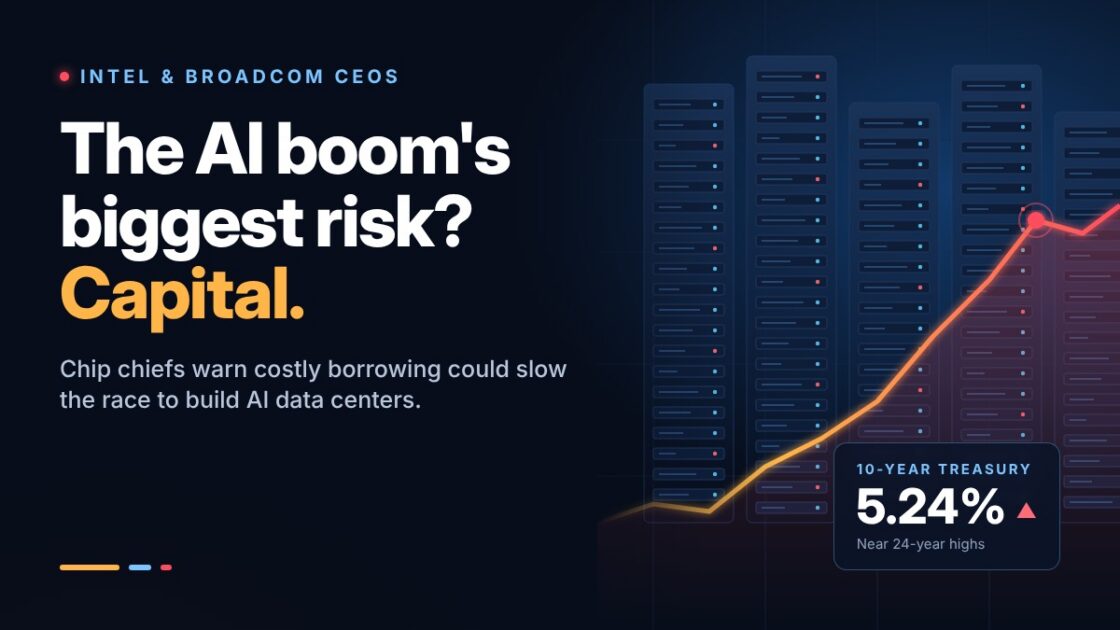
The warning lands at a sensitive moment. Long-term U.S. borrowing costs are hovering near their highest levels in more than two decades, while the price of the chips and storage that AI data centers depend on keeps climbing. Neither executive predicted a near-term slowdown, but both suggested the boom’s staying power will come down to whether its financing and its returns can keep pace with its ambitions.
Why financing has become the pressure point
AI developers and cloud providers have committed enormous sums to data centers and computing capacity, wagering that demand for AI services will keep rising steeply. That bet now faces two costs moving in the wrong direction at once.
The first is hardware. Heavy demand for processors and storage has pushed prices higher, which means every new facility costs more to equip than planned.
The second is the cost of money itself. When companies borrow to fund construction, higher interest rates raise the bar each project must clear to justify itself. Put the two together and spending plans that looked comfortable a year ago start to look stretched.
The yield picture
According to the original report, the benchmark 10-year Treasury yield has stayed above 5% since mid-September. Here is where key rates stood as of the report:
| Measure | Level | Context |
|---|---|---|
| 10-year Treasury yield | 5.24% | Slightly below its recent 24-year high; above 5% since mid-September |
| 30-year Treasury yield | 5.60% | Eased slightly from recent highs but still elevated |
Treasury yields serve as a reference point for corporate borrowing. When they stay high, companies raising debt generally have to offer investors richer returns to attract funding. For an industry that needs a continuous stream of capital to keep building, a prolonged stretch of expensive debt could become a real brake on new projects.
A strong outlook, with conditions attached
For all the caution, neither CEO sounded alarmed about the immediate future.
Intel’s Tan said he expects conditions to stay favorable for the next two to three years and sees no significant slowdown in that window. For Intel, which is in the middle of a turnaround effort under Tan, who took the top job in 2025, that outlook matters: continued AI spending is a key source of demand for its chips and manufacturing ambitions.
The longer view is less certain. Both executives said growth beyond the next few years will depend on how quickly businesses actually adopt AI and whether the promised economic gains materialize. Investors have funded the buildout on the expectation of strong returns, and that expectation will eventually need evidence behind it.
Technology has to keep delivering
Broadcom’s Tan added a second condition. The technology itself, he cautioned, must keep improving. If AI capabilities stall, the case for ever-larger computing infrastructure weakens, and demand for the hardware that companies like Broadcom and Intel supply could cool.
That point links the financing question to the product question. Lenders and shareholders are more willing to fund expansion when each generation of AI models clearly does more than the last. Slower progress would make the capital argument harder to win, especially at today’s rates.
What it means for the AI buildout
The remarks reflect a shift in how industry insiders are framing the boom’s risks. Earlier debates centered on supply bottlenecks: whether chipmakers could produce enough advanced processors, or whether power grids could support new data centers. Hock Tan and Lip-Bu Tan are pointing to something more basic. Even with the hardware available, someone has to pay for it, and the price of paying has gone up.
Why these two voices carry weight
Broadcom supplies custom AI chips and networking hardware to some of the largest cloud and AI companies, giving its CEO a direct view of customer spending plans. Intel, as one of the oldest names in semiconductors, sits on both the design and manufacturing sides of the industry. When executives from companies that benefit from AI spending flag financing as a risk, the warning carries more weight than it would from outside skeptics.
For now, the money is still flowing. The open question the two CEOs raised is how long it can keep flowing at this pace if borrowing stays expensive and the payoff takes longer than investors hope.
Disclaimer: This content was partially produced with the help of AI tools and This content is for informational purposes only and not investment advice.